


XII. Black
XII. Black
4 min read
From a very young age, black has been part of my work. I remember this habit I had of using it in my drawings in art class. One day, the subject was to paint a seascape. I had, as usual, outlined every subject with a black line. My teacher was furious: but really, things are not surrounded by black! She was right, of course. But that line was not there to describe what I saw. It was there because without it, the forms did not exist.
Years later, the first major piece, a cross of more than three metres covered in electronic circuits, a human skeleton crucified on it, was entirely painted in glossy black. The Devil's Dice that followed, same circuits, same glossy monochrome. Black was always there.
What changed was its nature. The glossy black of the early pieces had a presence of its own. It reflected light, caught the eye, gave surfaces an autonomous life. The piece existed through its form, but also through what the black did with the space around it: the reflections, the distortions, the environment captured in the lacquer. Gloss does not recede, it dialogues.
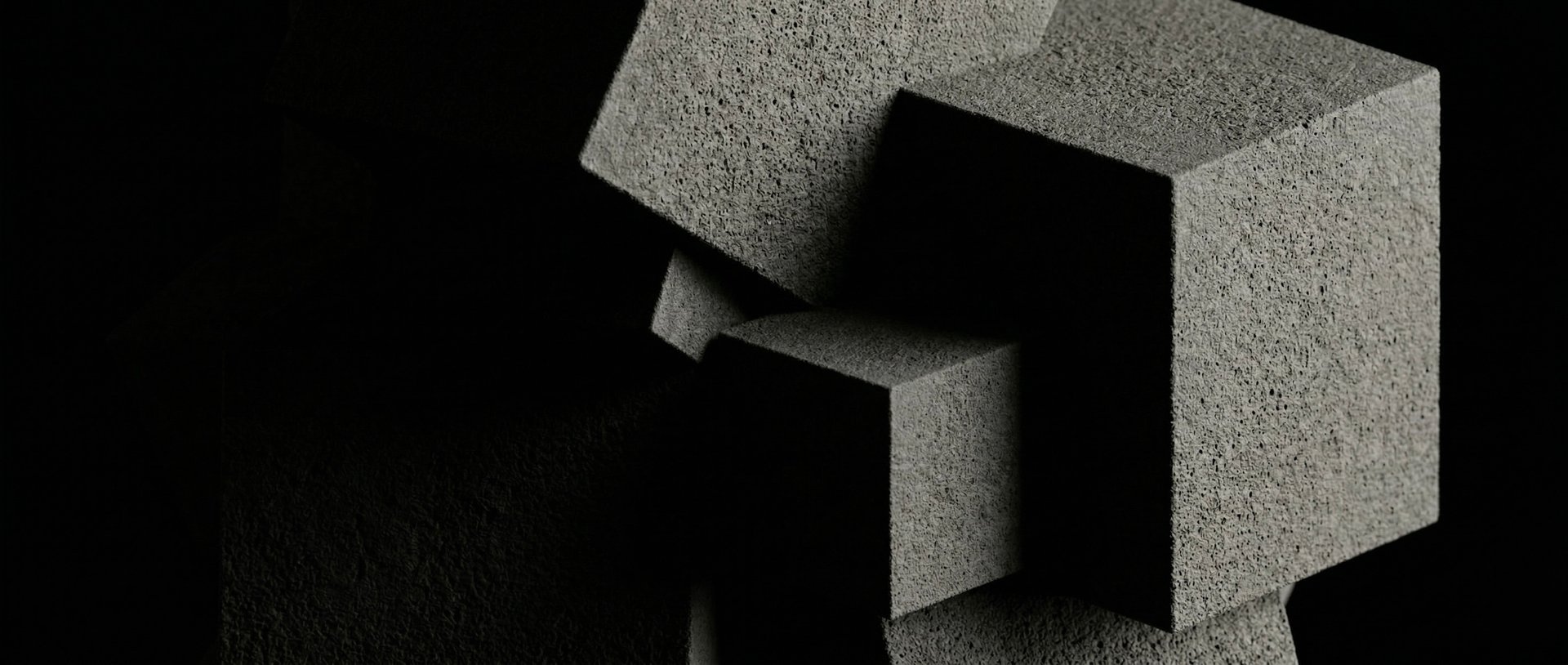
The matte black of the Pyrite pieces does exactly the opposite. It absorbs. It strips the surface of all autonomy to let only the geometry exist. When light strikes a matte cube, it does not come back. It draws an edge, marks an angle, reveals a plane, then disappears. Matte does not dialogue with space, it withdraws from it so that form alone advances.
This shift from gloss to matte follows the same trajectory as that from figuration to abstraction. The cross and its skeleton spoke of the body, the sacred, technology. They needed gloss because they carried a symbolic charge, and gloss amplifies what shows itself. The Pyrite pieces carry something else, something quieter, that does not pass through image but through form. Matte is the logical consequence of this shift.
Black arrived before everything else. Before the geometry, before pyrite, before the formal vocabulary that structures the entire body of work today. It was never a choice. It was self-evident, the way certain things are without needing to be decided.
" Where for some it means mourning, mine means life."
Black is not a colour in my work. It is a tool of subtraction. It absorbs the entire spectrum of colours, and with them everything that could compete with form. Thermopolymer is neutral, black makes it invisible. What remains is only geometry: the angles, the interlocking, the relationships of mass. Nothing else.
There is also something vaster. The black of the universe, that absolute black which contains everything, precedes everything, which is the very space in which matter appears. The black in which I work carries something of that. It is not an absence. Where for some it means mourning, mine means life. It is the space from which form emerges, the ground without which nothing takes form.
This is also what often distinguishes the sculptures from the furniture. The sculptures exist through form alone, and black is what makes that solitude possible. Furniture, because it is inhabited, because it coexists with people and objects in a domestic space, more often calls upon the presence of materials: walnut, polished brass, labradorite, marble. Each carries its own colour, its own light, its own warmth. But the boundary is not fixed. When the formal logic of a furniture piece demands it, black asserts itself with the same self-evidence. I sometimes look at a finished Pyrite piece and no longer see the material at all, only the cubes, their relationships, the way they interlock and truncate. Black has done its work when you forget it is there.
I have sometimes thought about what a Pyrite sculpture would look like in another colour. Pure white, for example. White reveals shadows differently, it is more generous with light, it lets you see the surface subtleties that matte black absorbs. But white has a softness that the work does not call for. It softens edges instead of asserting them, it invites where black imposes. This is not a question of aesthetics, it is a question of rightness. The geometry I work with is not soft. It is exact. And black is the only surface that is as exact as it is.
4 min read
From a very young age, black has been part of my work. I remember this habit I had of using it in my drawings in art class. One day, the subject was to paint a seascape. I had, as usual, outlined every subject with a black line. My teacher was furious: but really, things are not surrounded by black! She was right, of course. But that line was not there to describe what I saw. It was there because without it, the forms did not exist.
Years later, the first major piece, a cross of more than three metres covered in electronic circuits, a human skeleton crucified on it, was entirely painted in glossy black. The Devil's Dice that followed, same circuits, same glossy monochrome. Black was always there.
What changed was its nature. The glossy black of the early pieces had a presence of its own. It reflected light, caught the eye, gave surfaces an autonomous life. The piece existed through its form, but also through what the black did with the space around it: the reflections, the distortions, the environment captured in the lacquer. Gloss does not recede, it dialogues.
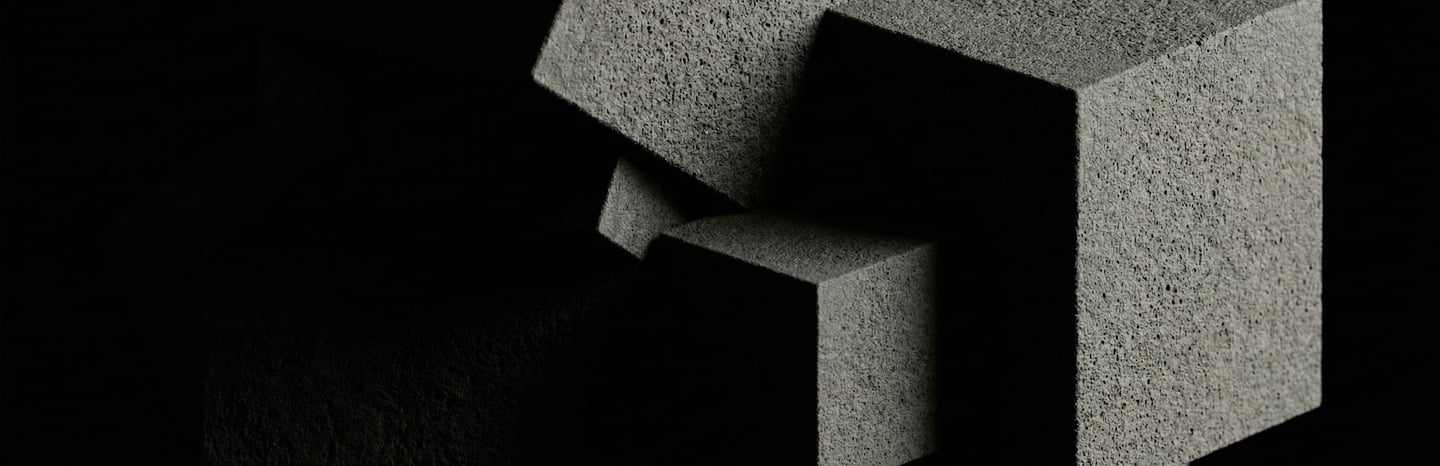
The matte black of the Pyrite pieces does exactly the opposite. It absorbs. It strips the surface of all autonomy to let only the geometry exist. When light strikes a matte cube, it does not come back. It draws an edge, marks an angle, reveals a plane, then disappears. Matte does not dialogue with space, it withdraws from it so that form alone advances.
This shift from gloss to matte follows the same trajectory as that from figuration to abstraction. The cross and its skeleton spoke of the body, the sacred, technology. They needed gloss because they carried a symbolic charge, and gloss amplifies what shows itself. The Pyrite pieces carry something else, something quieter, that does not pass through image but through form. Matte is the logical consequence of this shift.
Black arrived before everything else. Before the geometry, before pyrite, before the formal vocabulary that structures the entire body of work today. It was never a choice. It was self-evident, the way certain things are without needing to be decided.
" Where for some it means mourning, mine means life."
Black is not a colour in my work. It is a tool of subtraction. It absorbs the entire spectrum of colours, and with them everything that could compete with form. Thermopolymer is neutral, black makes it invisible. What remains is only geometry: the angles, the interlocking, the relationships of mass. Nothing else.
There is also something vaster. The black of the universe, that absolute black which contains everything, precedes everything, which is the very space in which matter appears. The black in which I work carries something of that. It is not an absence. Where for some it means mourning, mine means life. It is the space from which form emerges, the ground without which nothing takes form.
This is also what often distinguishes the sculptures from the furniture. The sculptures exist through form alone, and black is what makes that solitude possible. Furniture, because it is inhabited, because it coexists with people and objects in a domestic space, more often calls upon the presence of materials: walnut, polished brass, labradorite, marble. Each carries its own colour, its own light, its own warmth. But the boundary is not fixed. When the formal logic of a furniture piece demands it, black asserts itself with the same self-evidence. I sometimes look at a finished Pyrite piece and no longer see the material at all, only the cubes, their relationships, the way they interlock and truncate. Black has done its work when you forget it is there.
I have sometimes thought about what a Pyrite sculpture would look like in another colour. Pure white, for example. White reveals shadows differently, it is more generous with light, it lets you see the surface subtleties that matte black absorbs. But white has a softness that the work does not call for. It softens edges instead of asserting them, it invites where black imposes. This is not a question of aesthetics, it is a question of rightness. The geometry I work with is not soft. It is exact. And black is the only surface that is as exact as it is.
BACK TO JOURNAL