I. Pyrite, or perfection as accident
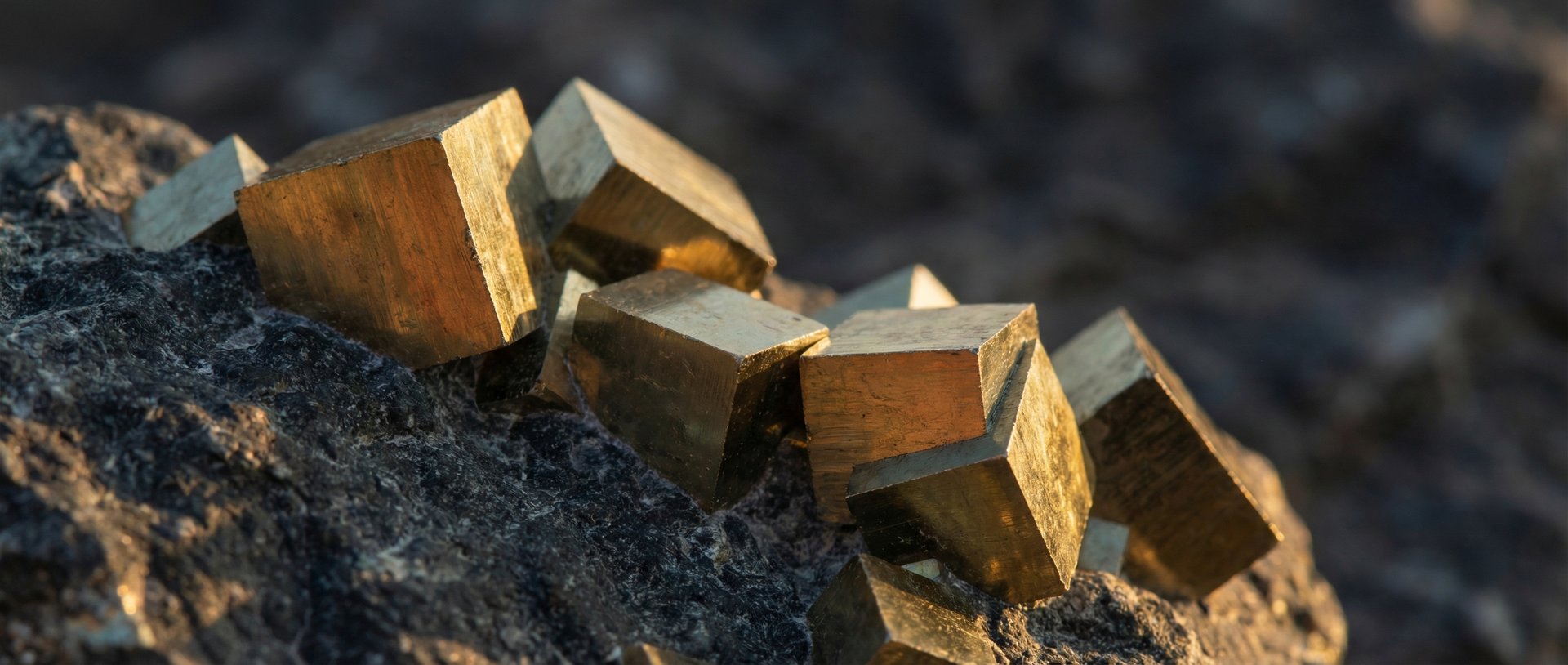
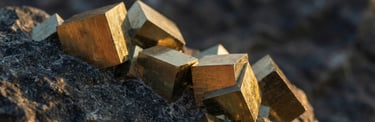
I first discovered pyrite at the gallery of geology and mineralogy in the Jardin des Plantes, in Paris. Much later, I found one by chance in my own garden, a few centimetres at most. The old lady who had lived in my apartment before me collected minerals, some were still there when I moved in. The pyrite had ended up in the earth, most likely lost. I cleaned it and looked at it for a long time. Regular cubes, interlocked with a rigour that had nothing decorative about it, and on each face fine striations, perpendicular from one face to the next, as if something beneath the surface had decided the orientation of every line. I sensed an intention where there was none. That sensation never left me.
Pyrite is not beautiful the way a flower is beautiful. A flower seeks to seduce, that is its function. The beauty of pyrite has no function. It is the by-product of crystallographic laws that have nothing to do with aesthetics. It is precisely this gratuitousness that makes it fascinating. Beauty is its consequence, not its project.
There are minerals that seem to have been designed by someone. Pyrite is one of them. This is not a poetic impression: it is something you feel before you can put it into words, standing before its cubic crystals of absolute precision, indifferent to everything they produce in the person observing them.
" Nature does not draw, it solves. And what it solves, when you look closely, is more beautiful than anything one could have invented."
I do not work to reproduce the mineral, that ambition would be futile. What holds me is the formal principle: a logic of absolute economy that generates form without seeking it. To extract that principle, to subject it to other materials, other scales.
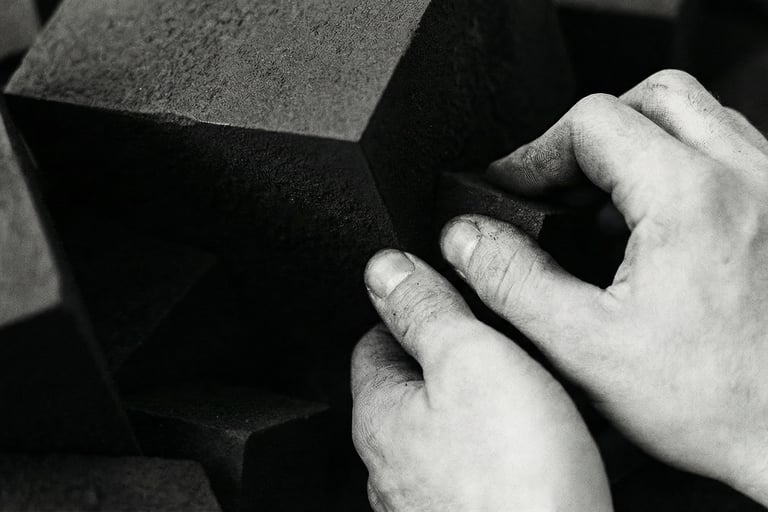
The current series did not emerge all at once. The first pieces were isolated, truncated cubes, covered in electronic circuits salvaged from computers and televisions, then painted in glossy black monochrome. A single crystal. That was the Devil's Dice series. It already carried the formal vocabulary, the monochrome, the density of surface, but it remained on the threshold of something. The shift to the Pyrite series happened when I began working with interlocking: no longer one cube but dozens, of different sizes, intertwined according to a logic that had to hold both visually and structurally. The movement went from something simple toward something more complex, conceptually but also technically.
Wood was the first material of the Pyrite series. Each cube required cuts at precise angles, and that precision, multiplied by the number of cubes and the complexity of the interlocking, made the work extremely long. An error in angle would propagate through the entire piece. Thermopolymer came next: its neutrality lets the form express itself without competition, and it allows an interlocking complexity that wood made nearly impracticable.
The pieces exist in two formats: wall-mounted or on pedestal. Each one is unique, none is reproduced or editioned. This is not an argument, it is constitutive of the approach. An interlocking of cubes cannot be repeated without losing what grounds it: the sensation that this configuration, and no other, had to exist.
What pyrite taught me comes down to one observation. Nature does not draw, it solves. And what it solves, when you look closely, is more beautiful than anything one could have invented.
I. Pyrite, or perfection as accident
3 min read
I first discovered pyrite at the gallery of geology and mineralogy in the Jardin des Plantes, in Paris. Much later, I found one by chance in my own garden, a few centimetres at most. The old lady who had lived in my apartment before me collected minerals, some were still there when I moved in. The pyrite had ended up in the earth, most likely lost. I cleaned it and looked at it for a long time. Regular cubes, interlocked with a rigour that had nothing decorative about it, and on each face fine striations, perpendicular from one face to the next, as if something beneath the surface had decided the orientation of every line. I sensed an intention where there was none. That sensation never left me.
Pyrite is not beautiful the way a flower is beautiful. A flower seeks to seduce, that is its function. The beauty of pyrite has no function. It is the by-product of crystallographic laws that have nothing to do with aesthetics. It is precisely this gratuitousness that makes it fascinating. Beauty is its consequence, not its project.
There are minerals that seem to have been designed by someone. Pyrite is one of them. This is not a poetic impression: it is something you feel before you can put it into words, standing before its cubic crystals of absolute precision, indifferent to everything they produce in the person observing them.
" Nature does not draw, it solves. And what it solves, when you look closely, is more beautiful than anything one could have invented."
I do not work to reproduce the mineral, that ambition would be futile. What holds me is the formal principle: a logic of absolute economy that generates form without seeking it. To extract that principle, to subject it to other materials, other scales.
The current series did not emerge all at once. The first pieces were isolated, truncated cubes, covered in electronic circuits salvaged from computers and televisions, then painted in glossy black monochrome. A single crystal. That was the Devil's Dice series. It already carried the formal vocabulary, the monochrome, the density of surface, but it remained on the threshold of something. The shift to the Pyrite series happened when I began working with interlocking: no longer one cube but dozens, of different sizes, intertwined according to a logic that had to hold both visually and structurally. The movement went from something simple toward something more complex, conceptually but also technically.
Wood was the first material of the Pyrite series. Each cube required cuts at precise angles, and that precision, multiplied by the number of cubes and the complexity of the interlocking, made the work extremely long. An error in angle would propagate through the entire piece. Thermopolymer came next: its neutrality lets the form express itself without competition, and it allows an interlocking complexity that wood made nearly impracticable.
The pieces exist in two formats: wall-mounted or on pedestal. Each one is unique, none is reproduced or editioned. This is not an argument, it is constitutive of the approach. An interlocking of cubes cannot be repeated without losing what grounds it: the sensation that this configuration, and no other, had to exist.
What pyrite taught me comes down to one observation. Nature does not draw, it solves. And what it solves, when you look closely, is more beautiful than anything one could have invented.
3 min read